

Before You Automatically Say “Yes” to Your Employer Plan…
If you’re like most people, you probably assume your employer health insurance is your best—or only—option.
But here’s the truth:
That’s not always the case.
If you’re relatively healthy, you may be overpaying for coverage that doesn’t actually fit your lifestyle… while missing out on options that could offer:
Lower monthly premiums
More flexibility
Nationwide access to doctors
This guide will help you understand when it actually makes sense to consider a private underwritten PPO plan—and when it doesn’t.
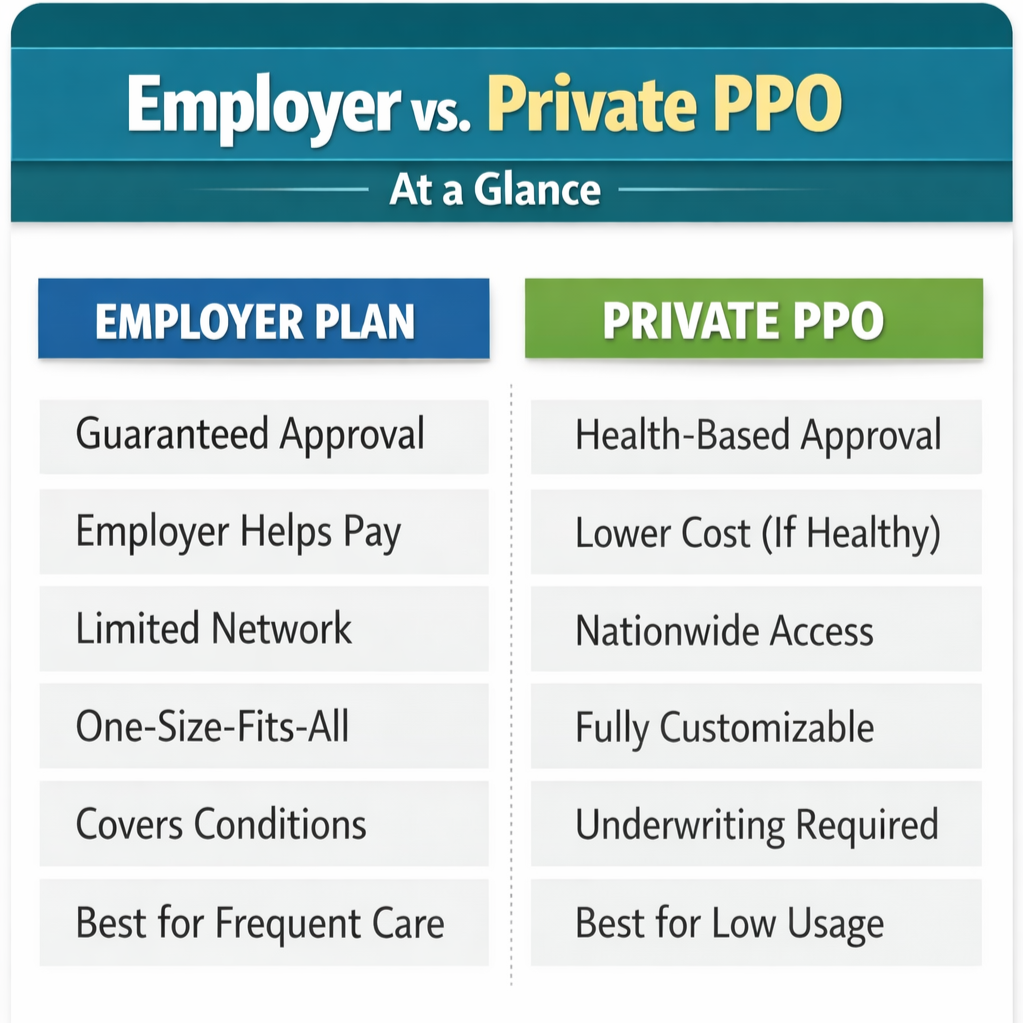
First—What’s the Difference?
Employer Health Insurance
No health questions (guaranteed approval)
Employer may cover part of the cost
Often limited networks (HMO or regional plans)
One-size-fits-all coverage
Private Underwritten PPO Plans
Requires approval based on health
Typically designed for healthy individuals
Offers nationwide PPO access
Fully customizable to your needs
When a Private PPO Plan Might Be the Better Fit
✅ 1. You’re Healthy and Don’t Use Insurance Often
If you:
Rarely go to the doctor
Don’t have chronic conditions
Aren’t on expensive medications
You could be paying for more coverage than you actually use.
Private PPO plans often reward good health with lower monthly costs.
✅ 2. Your Employer Plan Feels Expensive (Especially for Family)
This is one of the biggest reasons people explore alternatives.
Employers often:
Help pay for your premium
But pass most of the cost to your spouse and kids
That’s where costs can skyrocket.
In many cases, families can find better pricing and flexibility outside the employer plan.
✅ 3. You Need Nationwide Coverage
If your lifestyle includes:
Traveling for work
Living in multiple states
Wanting freedom to choose doctors
Employer plans can feel restrictive.
Private PPO plans typically allow you to:
See providers across the country
Skip referrals to specialists
Keep consistent coverage wherever you go
✅ 4. You’re Self-Employed or 1099
If you don’t have access to an employer plan, you’ve likely seen marketplace options that are:
Expensive
Limited in network access
Not very flexible
If you’re healthy, a private PPO plan may offer:
Better pricing
Stronger networks
More control over your coverage
✅ 5. You Want Control Over Your Plan
Employer plans are designed for groups—not individuals.
With a private plan, you can:
Choose your deductible
Adjust your coverage
Build a plan that actually fits your life
When You Should Stay With Your Employer Plan
Let’s be clear—private PPO plans are not for everyone.
Here’s when sticking with your employer plan is usually the smarter move:
🚫 You Have Pre-Existing Conditions
Private plans require medical approval.
Employer plans:
Accept everyone
Cover pre-existing conditions
🚫 Your Employer Pays Most of the Premium
If your employer heavily subsidizes your plan, it can be hard to beat financially.
🚫 You Need Frequent or Ongoing Care
If you:
See doctors regularly
Need ongoing treatments
Rely on expensive prescriptions
A traditional plan may offer more predictable coverage.
The Simple Decision Framework
Use this as a quick gut-check:
👉 Consider a Private PPO if:
You’re healthy
You want lower monthly costs
You value flexibility and nationwide access
👉 Stick With Employer Coverage if:
You have ongoing health conditions
Your employer covers a large portion of your premium
You need consistent, frequent care
The Biggest Mistake People Make
Most people don’t compare.
They assume:
“My employer plan must be the best option.”
But without looking at alternatives, you may be:
Overpaying.
Over-insured in areas you DON’T use.
Underutilizing better options available to you.
Want to Know What Actually Makes Sense for You?
The right plan depends on:
Your health.
Your budget.
Your lifestyle.
Your risk tolerance.
A quick comparison can help you see your options clearly—without the confusion.
👉 Next Step
If you’re curious whether a private PPO plan could be a better fit, the best next step is a simple, no-pressure review.
You’ll walk away knowing:
What you currently have
What else is available
What actually makes the most sense for your situation
Because the right health insurance plan shouldn’t just be what’s offered…
it should be what fits your life.